
Enterprise data analytics is evolving toward increasingly intelligent AI-powered business intelligence platforms, capable not only of visualizing information but also of simplifying data discovery, interpretation, prediction, and operational use.
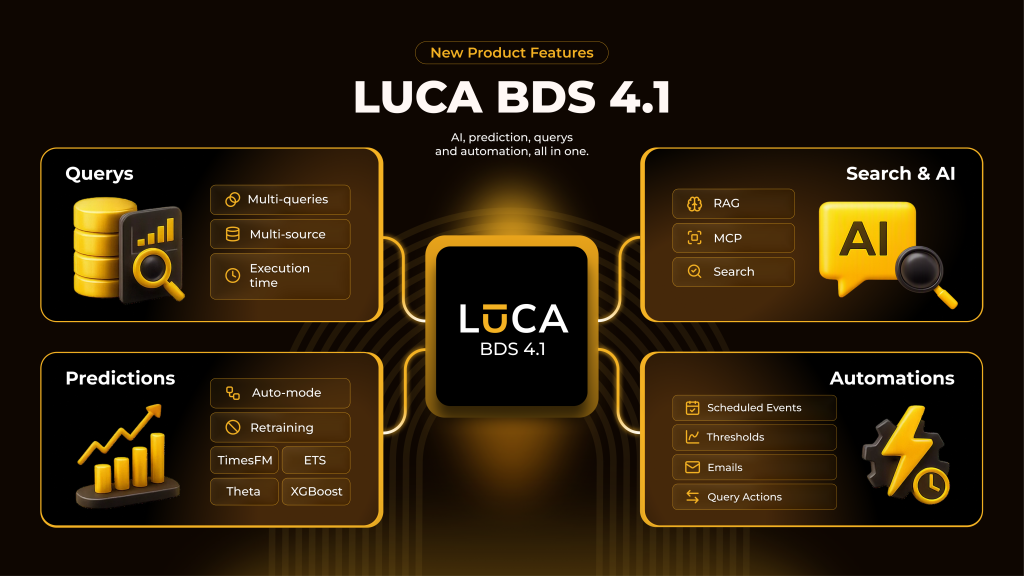
Following this trend, LUCA BDS 4.1 continues to evolve with new capabilities designed to streamline data access and exploitation, enhance artificial intelligence usage, and expand process automation. This new release focuses its main innovations on four key areas: queries, artificial intelligence, prediction, and automation, strengthening the platform’s ability to analyze, integrate, and act on information.
Queries: More Advanced Analysis Across Distributed Data
LUCA BDS 4.1 expands the query capabilities of the platform with local AI, introducing multiqueries and multi-source queries that facilitate the creation of more sophisticated analyses over distributed information.
Multiqueries
Multiqueries allow users to build new queries based on the results of one or multiple previous queries.
This approach enables query results to be chained and reused as the foundation for new calculations, transformations, or analyses.
Previous queries can originate from the same data source or from different sources, making it possible to create more complex analytical workflows without first consolidating all information into a single system.
Multi-Source Queries
Multi-source queries make it possible to combine information from two or more data sources within a single query.
For example, users can relate data stored across different databases or systems, similarly to performing a JOIN between separate sources. This enables unified analysis of information that was previously isolated across multiple environments.
Query Execution Time Visibility
LUCA BDS now displays the execution time of queries, providing greater traceability into query behavior and helping identify operations that require additional processing capacity.
Together, these enhancements enable more advanced analytics on distributed information while providing greater flexibility in leveraging multiple connected data sources.
More Artificial Intelligence: RAG, MCP, and Semantic Search
Artificial intelligence is another area that sees major advancements in this release, particularly through new RAG (Retrieval-Augmented Generation) and MCP (Model Context Protocol) capabilities.
RAG allows organizations to incorporate corporate documentation and business knowledge into the context used by AI models. As a result, responses can be grounded in company-specific information, delivering more accurate, contextualized, and reliable outputs.
MCP extends AI model capabilities by connecting them, through a standardized protocol, to external tools, services, and information sources. This enables AI systems to evolve beyond simple response generation and become capable of accessing and leveraging external resources as part of their reasoning and decision-making processes.
Semantic Search for Corporate Knowledge
LUCA BDS 4.1 also introduces a semantic search engine, allowing users to manually explore the documents available within the RAG environment.
Unlike traditional keyword-based searches, semantic search leverages the same semantic engine used across the platform, identifying information based on meaning and context rather than exact word matches.
This makes it possible to locate documents or content fragments that are conceptually related to a user’s request, even when they do not contain the exact search terms.
These new capabilities enable organizations to make better use of corporate knowledge by connecting artificial intelligence with the information and tools required in each specific business context.
Enhanced Forecasting: Automatic Selection, Retraining, and New Models
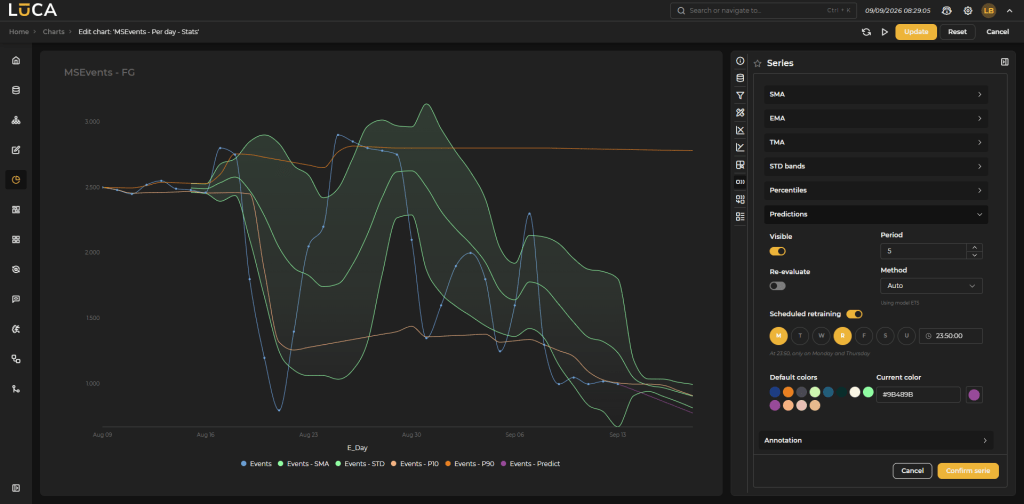
The predictive analytics area introduces significant improvements aimed at increasing accuracy while automating model maintenance.
Automatic Model Selection
The new automatic mode evaluates available forecasting models and selects the one that minimizes prediction error for each use case.
This allows LUCA BDS to automatically determine which algorithm delivers the highest accuracy for the analyzed dataset, eliminating the need for users to manually select the most appropriate model.
Automatic Retraining
Predictive models can now be automatically retrained as new data becomes available.
This mechanism continuously updates model weights and parameters, ensuring forecasts evolve alongside changing data patterns and reducing the degradation in accuracy that often occurs over time.
New Forecasting Models
LUCA BDS 4.1 expands its catalog of predictive algorithms with the addition of:
- TimesFM
- ETS
- Theta
- XGBoost
These new models broaden the platform’s forecasting capabilities and support a wider range of time-series behaviors, trends, and patterns.
With these enhancements, LUCA BDS simplifies the application of predictive analytics while ensuring models remain accurate and continuously adapted to evolving data.
Expanded Automation Capabilities
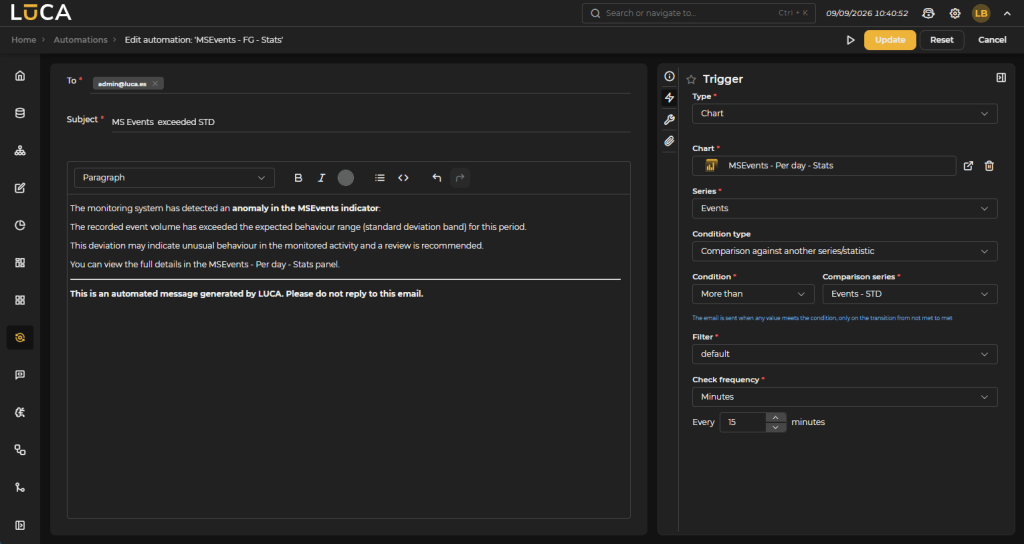
LUCA BDS 4.1 transforms the former Reporting menu into the new Automations module, significantly expanding the automation capabilities available within the platform.
Previously, Reporting was mainly focused on scheduling the periodic delivery of information. The new module enables users to create automations triggered by different types of events.
On one hand, organizations can configure time-based or scheduled events, preserving existing capabilities to execute actions at specific times or intervals. In addition, LUCA BDS now supports threshold-based events defined on platform charts and indicators. An automation can be triggered whenever a metric rises above or falls below a predefined value.
When one of these events occurs, LUCA BDS can automatically:
- Send an email notification.
- Execute a query.
The ability to execute queries significantly expands platform capabilities, allowing automations to interact with databases, APIs, or other connected systems rather than simply generating notifications.
As a result, LUCA BDS can move beyond information analysis and automatically trigger actions whenever data meets predefined conditions.
This additional automation layer brings LUCA BDS closer to a true self-service BI model, empowering business teams to manage and act on their own intelligence without relying on IT departments.
A Smarter, More Automated, and More Connected Platform
With this release, LUCA BDS takes another step toward becoming a smarter, more automated, and more connected platform, capable not only of analyzing information but also of anticipating outcomes, providing context, and taking action.
The new query capabilities simplify analysis across distributed data sources. RAG and MCP expand the possibilities of artificial intelligence. Predictive enhancements automate model selection and maintenance. The new automation module enables data-driven events to trigger actions across connected systems.
Want to see these capabilities applied to your own data?