Why Is On-Premise BI Critical for Data Governance and Compliance?
From a technical standpoint, on-premise BI allows organizations to retain full ownership of data assets across the entire lifecycle, from ingestion and storage to processing and analytics execution.
This capability is critical when implementing enterprise data governance frameworks, where access control models, data lineage tracking, and auditability must be enforced with precision. Unlike cloud environments, which operate under shared responsibility models, on-premise setups provide a fully controlled governance layer, enabling organizations to define identity management, security policies, and data access rules internally.
This makes on-premise analytics platforms for compliance and governance a key requirement in industries where regulatory pressure, data sensitivity, and traceability are essential.
On-Premise BI vs Cloud BI: What Are the Key Differences?
The choice between cloud and on-premise BI should be understood as an architectural decision rather than a binary alternative.
Cloud-based analytics platforms excel in elastic scalability, distributed processing, and rapid deployment, making them suitable for exploratory analytics and high-volume data workloads. However, they introduce dependencies related to data residency, governance enforcement, and third-party security configurations.
By contrast, on-premise BI environments deliver predictable performance, infrastructure-level control, and data sovereignty guarantees, which are essential when governance and compliance requirements outweigh the need for flexibility.
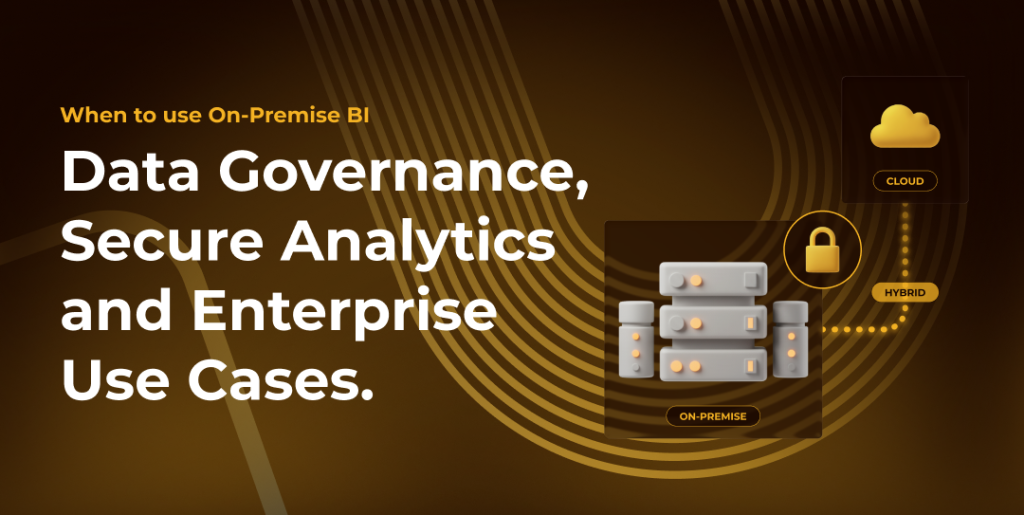
As a result, most enterprise strategies are evolving toward hybrid analytics architectures, where workloads are distributed based on governance, performance, and operational constraints.
When Is On-Premise BI Necessary? Key Enterprise Scenarios
On-premise BI becomes a strategic requirement when organizations need end-to-end control over data processing, access, and storage, particularly in environments where governance, security, and performance cannot be delegated.
This is especially relevant in regulated sectors such as telecommunications, finance, healthcare, and public administration. In these contexts, on-premise BI for regulatory compliance and auditability ensures full visibility into data flows and simplifies alignment with regulatory frameworks such as GDPR.
Security remains a primary driver. Organizations managing critical datasets must ensure data sovereignty and secure data processing environments, preventing exposure to external infrastructures. This enables the deployment of advanced security mechanisms such as identity and access management (IAM), encryption strategies, and network segmentation within controlled environments.
Integration challenges also play a key role. Many enterprise ecosystems rely on legacy systems, operational platforms, and IT/OT infrastructures where cloud-native integration is limited or not feasible. In these scenarios, on-premise BI provides direct connectivity to internal systems, enabling analytics closer to the data source and reducing architectural complexity.
Performance requirements further reinforce this model. Use cases such as network analytics, operational intelligence, and predictive maintenance depend on low-latency data processing and real-time analytics capabilities. Running analytics locally ensures consistent response times and removes dependencies on network performance.
Additionally, organizations investing in advanced analytics require greater flexibility than traditional BI tools provide. On-premise environments facilitate custom data pipelines, model deployment, and full control over processing logic, making them well suited for data-intensive and AI-driven use cases.
To summarize, on-premise BI is particularly relevant in the following scenarios:
| Scenario | Why On-Premise BI Is Required |
| Data governance & compliance | Full control over lineage, access policies, and auditability |
| Data sovereignty | Ensures data residency and infrastructure-level control |
| High-security environments | Enables custom IAM, encryption, and network segmentation |
| Legacy integration | Direct connectivity with enterprise IT/OT systems |
| Real-time analytics | Supports low latency and deterministic performance |
| Advanced analytics | Allows custom pipelines and ML model deployment |
What Is Hybrid BI and Why Is It Becoming the Standard Architecture?
While on-premise BI is essential for governance-dependent workloads, cloud environments provide the scalability required for modern data processing.
This has led to the adoption of hybrid BI architectures for enterprise analytics, where workloads are distributed dynamically according to their specific requirements. Sensitive data and governance-critical processes remain on-premise, while scalable analytics, AI workloads, and large-scale processing leverage cloud infrastructure.
This model enables organizations to balance data governance, performance optimization, and cost efficiency, while avoiding a one-size-fits-all approach. It reflects a broader shift toward data-centric architecture design, where deployment decisions are driven by workload characteristics rather than infrastructure trends.
How LUCA BDS Enables Secure On-Premise and Hybrid Analytics
Within this architectural landscape, LUCA BDS acts as a platform designed to enable secure, governance-driven analytics across on-premise and hybrid environments.
Unlike traditional BI solutions, LUCA BDS supports advanced analytics within controlled enterprise infrastructure, while maintaining the flexibility required for hybrid deployment models. Its architecture enables end-to-end data lifecycle management, ensuring that sensitive information remains within governed environments.
It also provides seamless integration with enterprise IT and OT systems, allowing organizations to build analytics capabilities across complex ecosystems. With support for real-time processing, batch analytics, custom pipelines, and machine learning deployment, LUCA BDS enables the creation of high-performance, secure analytics platforms aligned with enterprise governance requirements.
Conclusion
On-premise BI remains a critical component of enterprise analytics strategies in scenarios where data governance, regulatory compliance, security, and performance are essential.
Rather than being replaced, it is increasingly integrated into hybrid architectures that align each workload with its operational and technical requirements. This approach enables organizations to maintain control over sensitive data while leveraging scalability where it adds value.
Platforms such as LUCA BDS support this transition by providing a secure, flexible, and governance-oriented foundation for advanced analytics
Control is not a feature. It’s an architectural decision. Build it with LUCA BDS, where security, governance, and performance are non-negotiable.